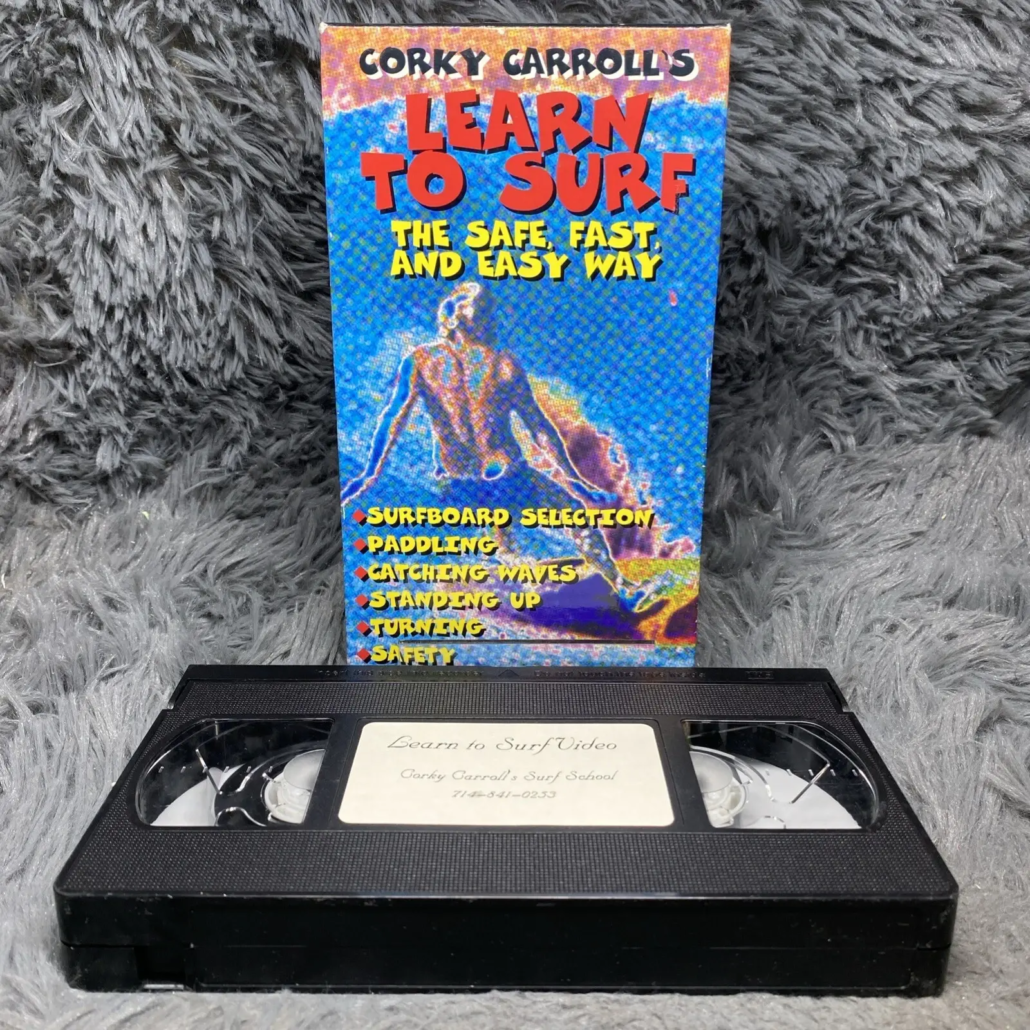
Back in 1996, we filmed one of the first ever surfing instructional videos. It was called Corky Carroll’s Learn to Surf the Safe, Fast and Easy Way.
Surf instructional videos might be a dime a dozen nowadays on YouTube, Instagram and TikTok but before that there weren’t many options and this is the godfather of them all.
If you’re a fan of Corky, the 90s, and own a DVD or VHS player, you can buy a copy on eBay and enjoy it at home.
Or you can just watch it above in full for free.
It might look dated, but the surf tips hold up, and watching Corky shred on his cowboard is a thing of beauty.
Corky Carroll’s Surf School opened operations in June of 1996. It was started by Rick Walker with the help of Corky Carroll. Up to then Rick had been working as a television producer in Los Angeles for a show called Life in Sports, which featured interviews with professional athletes from the past and present.
One of the athletes he interviewed for the show was Corky Carroll.
In case you don’t know, Corky is one of the most revered surfers in history. Long story short, Rick teamed up with Corky to start Corky Carroll’s Surf School and that very first summer, putting Rick’s background in TV to work, they shot a how-to instructional video on surfing.
In Corky’s own words, “I contend that this is still the best ‘learn how to surf’ tool, other than personal instruction itself, available.”
We’ll let you be the judge of that.
But if you’re learning to surf, Corky shares some genuinely great insight. It’s not every day you get to learn to surf from a surf legend. Don’t let the fact it was filmed last century fool you. Good surf instruction never goes out of style, and what was true then is just as useful to know today.
Even if it comes dressed in neon boardshorts.
Oh, and if you’re curious about that cowboard, Corky loves talking about his favorite surfboard. And yes that’s Corky singing at the end with a song he and Rick wrote specially for our surf school.
https://www.surfschool.net/wp-content/uploads/2019/07/corky-carrolls-surf-school-logo-header.jpg00Collin Walkerhttps://www.surfschool.net/wp-content/uploads/2019/07/corky-carrolls-surf-school-logo-header.jpgCollin Walker2026-05-16 18:18:562026-05-19 18:10:55Watch Corky Carroll Teach You to Surf — From 1996
Learning surf lingo is just as crucial as learning to catch a wave.
Sure, surf talk sounds cool. But it isn’t just for show — it’s your ticket to progressing, staying safe, and sounding like you belong.
You might wipeout every wave, but if you can drop some surf slang into casual conversation, no one will even notice you paddled out with your wetsuit on backward.
(Just kidding. Everyone will notice.)
So how’s your surfer?
Can you decode:
“It’s offshore and glassy, serving up fun little lefts with clean shoulders on the outside.”
How about:
“Going backside can be hard for goofy-footers, but with practice, you’ll learn to engage the rail to turn.”
Okay, last one:
“Waist-high beach break, or smaller, is best for beginner surfers.”
No worries if those went over your head. You’ll catch on by the end of this.
Surf Terms to Get You Started
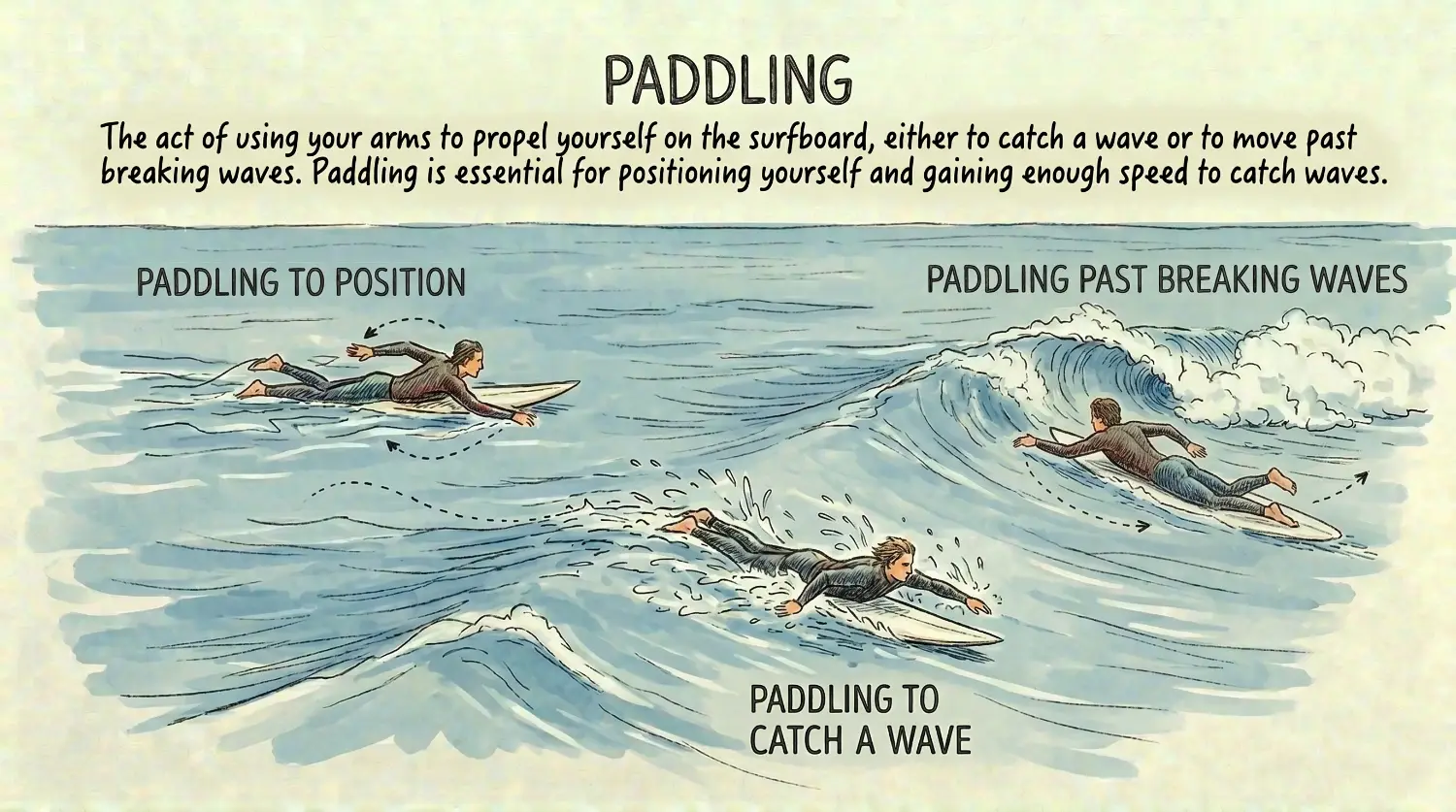
Paddling
The act of using your arms to propel yourself on the surfboard, either to catch a wave or to move past breaking waves. Paddling is essential for positioning yourself and gaining enough speed to catch waves.
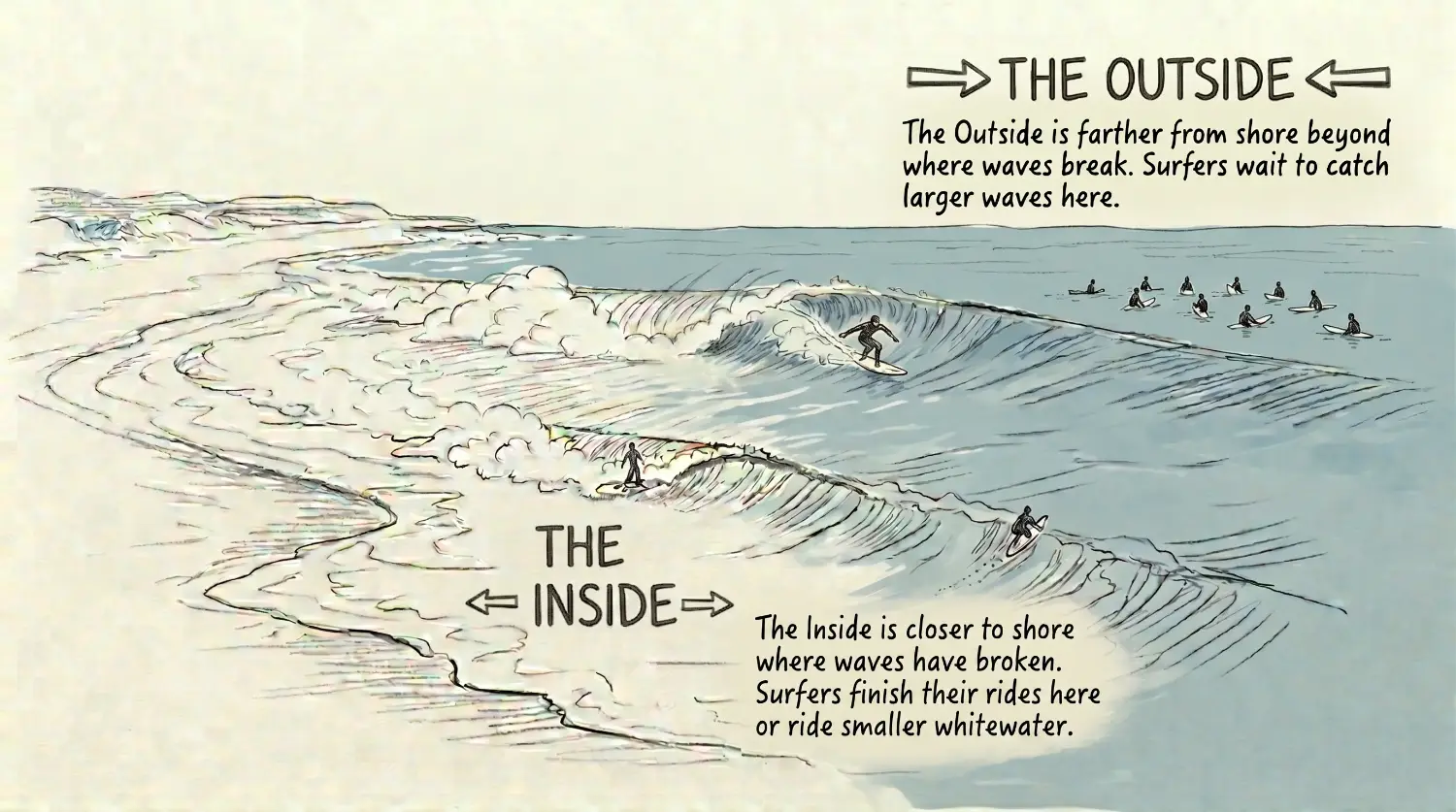
Inside
An area in the water closer to shore where waves have already broken, usually where surfers finish their rides or wait for smaller waves. This is often a good area for those brand new to surfing to practice.
Outside
An area further from shore where waves first start to break. Waves are typically bigger on the Outside than on the Inside.
If you’re in the water, and hear someone say “outside”, that means bigger waves are coming and you should paddle further from shore so they don’t break on top of you.
Lineup
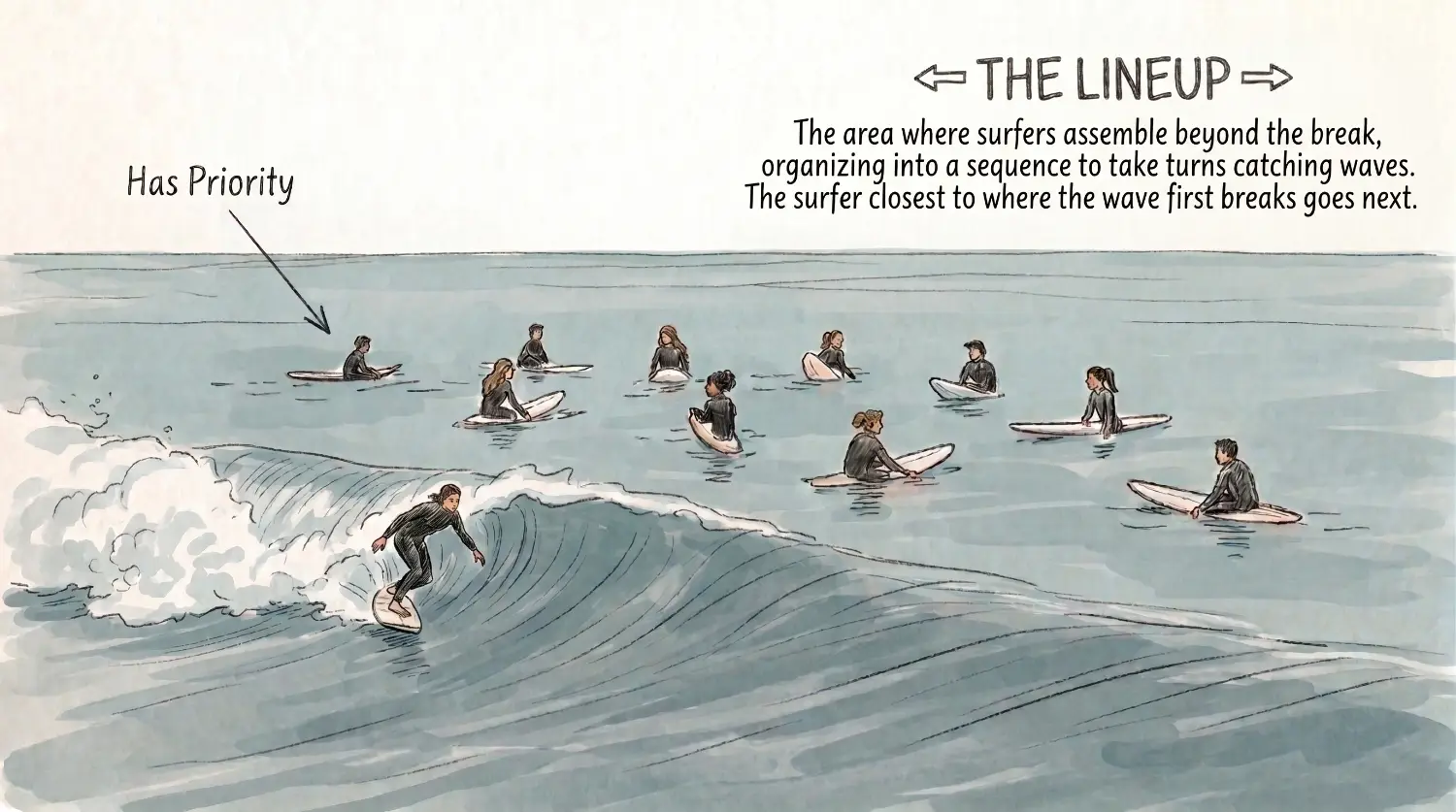
An area in the water just past the Outside where most surfers wait for waves. Here, surfers loosely form a line (hence the name) to wait their turn to catch breaking waves.
The surfer closest to where the wave first breaks has priority in the Lineup. After catching a wave, you return to the back of the line. Remember, don’t sneak in front of others—it’s bad surfing etiquette.
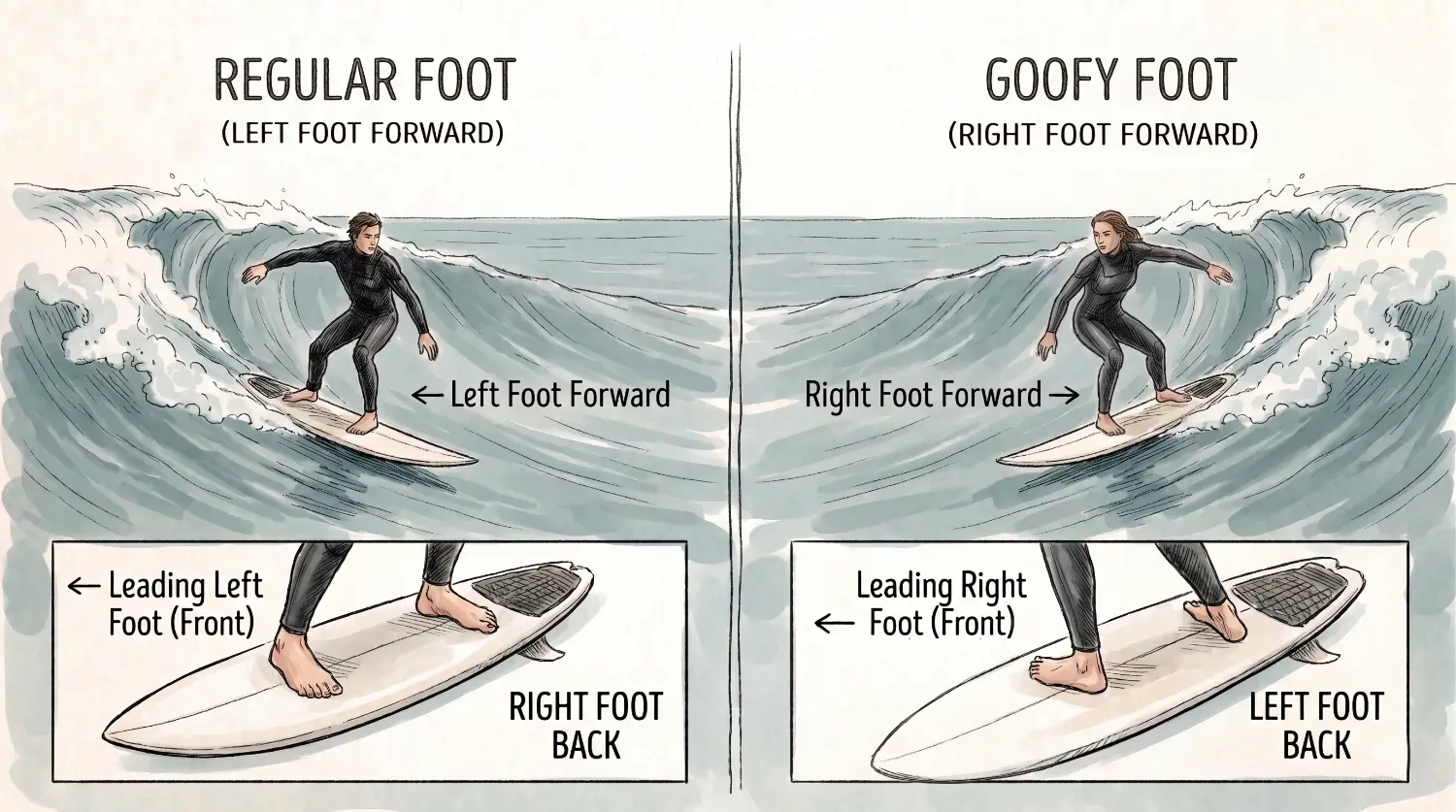
Regular Foot
A term to describe one type of surf stance. If when you stand up, your left foot is forward on the surfboard, and right foot at the back, then you’re a regular-footer.
Goofy Foot
The other type of surf stance. If you place your right foot forward on the surfboard, and left foot at the back, then you’re a goofy-footer.
Left
A wave that breaks to the left from the surfer’s point of view. If a surfer rides a wave to their left, we say “they’re going left.”
This term (and the next) are based on the surfer’s perspective while riding a wave, not how it looks from shore. Standing on the beach a wave appears to break to the right, but we would still call it a “left” because that’s the direction a surfer rides it from their point of view.
Right
A wave that breaks to the right from the surfer’s point of view. If a surfer rides a wave to their right, we say “they’re going right.”
Closeout
A wave that breaks all at once across its entire length rather than peeling gradually to the left or right. Because it creates a straight, impassable wall of whitewater, it offers no open face to ride.
A wave that breaks to the right from the surfer’s point of view. If a surfer rides a wave to their right, we say “they’re going right.”
Frontside
When a surfer rides a wave while facing the wave. Regular-footers surf Frontside when they go Right, while Goofy-footers surf Frontside when they go Left.
Backside
When a surfer rides a wave with their back to the wave. Regular-footers surf Backside when they go Left, while Goofy-footers surf Backside when they go Right.
It’s easier to ride a wave Frontside. You can see the wave in front of you. This means for Goofy-footers, a left (frontside) wave feels more natural, while a right (backside) wave feels more awkward. You should learn to surf in both directions, but in the beginning you’ll have an easier time learning to surf Frontside.
Glassy
When the ocean surface is smooth, calm, and reflective, resembling glass. This happens with little to no wind, creating ideal conditions for surfing, with well-formed waves sans chop or texture.
Clean
Similar to Glassy. The water and waves are smooth, with little to no chop or disturbance. But it can also mean the waves have a nice, well-defined shape when they break. If the surf is “clean”? Game on!
Wipeout
Falling off your board after losing balance or control on a wave.
Drop In
Catching a wave that another surfer is already riding.
Cutting off a surfer mid-ride is a big no-no in surf etiquette. Accidents happen, but it’s important to always keep an eye out for other surfers. Sometimes the best way to avoid dropping-in on others is to surf a little further away from where everyone else is.
Kook
Someone who lacks experience, or knowledge of surf etiquette. Kooks are unaware of the mistakes they make, or why they’re even mistakes at all. “Kook” is often used as derogatory term for a beginner surfer. But forget that! We’re here to say it’s okay to be a kook.
We’re all just kooks in-training.
We don’t know what we don’t know, until we learn. That’s why Corky Carroll’s Surf School exists: to help you learn.
Stoked
What surfing is all about. Being excited, happy, thrilled, amped, jazzed, charged, hyped, ecstatic, and pumped up about something, like catching a great wave or eating In-N-Out. Just wait. You’ll be using this one on the regular in no time.
Set
A group of waves that arrive together (also known as set waves).
A set typically has 3-7 waves. Its first wave will often be the smallest and the last the largest. A lull is the calm period in-between sets, with little or no waves at all. A clean-up set is a set of bigger-than-usual waves that break further outside, scattering the lineup.
Wave vs. Swell
A wave is any rise and fall of water, usually created by wind blowing across the ocean. A swell is a type of wave that was created by wind far away and its energy has become smooth and organized as it travels across the ocean.
In surfing, swells form into the clean, rideable waves that surfers look for.
Surf Slang: Anatomy of a Wave
A wave has several different components worth knowing:
Peak — the point where the wave first breaks, or curls. It’s the highest point the wave, identifiable as the spot where white foam first appears.
Face — the sloping part of the wave that extends down from the peak, or lip. When a surfer is riding a wave they are moving along the Face.
Lip — the uppermost edge, or top crest, along a wave.
Pocket — the steepest, most powerful part of the wave that is still ridable, located just in front of the breaking section.
Shoulder — the end section of the face that fades into flat water. This area of the wave is less steep and powerful, and more manageable for beginner surfers to ride. But it can be harder to catch a wave on the Shoulder than by the Peak.
Impact Zone — the area where a breaking wave crashes down directly into the water surface.
Whitewater — the foamy, broken part of a wave after it crashes. Whitewater typically occurs closer to shore, and is a safer area for beginners to practice.
Each wave component plays a different role in catching and riding waves.
Wind Lingo: Offshore & Onshore
Two different terms to describe wind conditions.
Offshore is when the wind blows from land toward the ocean. This type of wind can smooth the wave, create a more surfable face, and even hold the wave up longer before it breaks.
Onshore is when the wind blows from the ocean toward land. Onshore wind is not great for surfing because it turns the water choppy and causes waves to break faster.
You can tell which type of wind is blowing by looking at nearby forecasting app like Surfline or Windy.
If you’re at the beach, take a look at any nearby flags or wind socks. If a flag is pointing away from the water, the wind is onshore. If it’s pointing towards the water, the wind is offshore.
While an offshore wind is preferred by many surfers, for beginners the best wind is no wind at all.
Wind plays such an important role in surfing for so many reasons that the more you surf the more you’ll become obsessed with it.
Surfboard Terms
Here’s a quick definition of each part of a surfboard:
Nose – The front tip of the surfboard.
Deck – The top surface of the surfboard where surfers stand and lay down.
Bottom – This one speaks for itself.
Tail – The back end of the surfboard.
Rail – The side edge of the board, running from nose to tail.
Fins – Small, blade-like structures on the underside of a board near the tail.
Leash – A cord that attaches the board to your back ankle to prevent losing your board in the water.
We’ll go into more detail about the what and whys of board design in another post.
Surf Break Terms
A surf break is where waves form in a surfable way, generated by what’s under the water or the coastline. Here are the main types of breaks.
Beach Break – Waves that break over sandy ocean floor. The most common break and beginner-friendly, but they can be unpredictable due to shifting sandbars. Bolsa Chica is a beach break.
Reef Break – Waves that break over a rocky or coral reef. These waves are typically consistent (like at San Onofre) and powerful (like at Pipeline).
Point Break – Waves that break along a point of land, such as headland or jetty. These waves often provide long, clean rides. Malibu is a point break.
River Mouth Break – Waves that form at the mouth of a river, via unique sandbars and currents. Seal Beach has a river mouth break.
Wave Height Terms
Discussing wave height can get testy. There’s no objective standard for qualifying the height of a wave, and many opinions on how to measure one.
Ignore the debate if you’re new to surfing. But it’s good to know some basic wave lingo and their approximate height in feet. Each reference the part of the body that a wave comes up to when a surfer is standing on a board.
Ankle-high – a 1 foot small, gentle wave perfect for beginners
Knee-high – about 2 feet. Also small, gentle waves, perfect for beginners
Waist-high – about 3 feet. The max most noobs will feel comfortable tackling
Chest-high – about 4 feet. Good size for seasoned beginners and intermediate surfers
Head-high – about 5 feet. More powerful waves, ideal for intermediate and advanced surfers
Overhead – 6+ feet. These waves pack a punch and are for more advanced surfers
Double Overhead – 10-13 feet. Twice your height. Big, powerful waves for expert surfers
Big Waves — 20+ feet. You’re Laird Hamilton
Surf Slang Few Use
Not all surf lingo has stood the test of time, or Hollywood.
Here’s some outdated or generally unused surf slang:
Cowabunga (unless you’re a Ninja Turtle)
Tubular
Hang loose
Shred the gnar
Righteous (unless you’re that turtle from Finding Nemo)
Hang ten
Surf’s up
Some do have accepted literal meanings.
Like hang ten, which refers to walking up the board to hang ten toes off the nose. An epic feat that’s the pinnacle of longboarding. But in any other context a line like, “hang ten, dude!” isn’t really used much by surfers.
Nor is “surf’s up.”
Literally, surf’s up means that the waves are good. Figuratively, it means let’s go have fun surfing. We love it. It’s a stoked expression. And a great movie. But it’s also become a mainstream catchphrase that can get overused, which is probably why you don’t it hear much at surf spots anymore.
That said, who cares.
Surfing is all about having fun. So as long as you’re staying safe and being mindful of the other surfers, the surf spot you’r at and your skill level, then the lingo you use is all a matter of preference and all part of having a good time. If you want to say, “Cowabunga dude! That was a righteous ride shredding the gnar on those tasty waves,” you might get some odd looks, but more power to you.
Why Knowing Surf Slang Matters for Beginners
Like any culture, surfing has its own language. It’s not as tough to learn as Chinese or Minion, but there’s for sure a learning curve.
No one expects you to be fluent overnight, but understanding basic surf slang is key for beginners to know what they’re learning, how to communicate in the lineup, and build confidence.
Proper surf talk also goes a long way towards staying safe.
If you can reference your surroundings and convey your intentions clearly, you’ll avoid confusion and reduce the risk of accidents in the water.
Alright. Let’s Test that Slang!
You should now be able to roll up to any surf spot and talk the talk. Certainly enough to know that when someone says….
“It’s offshore and glassy, serving up fun little lefts with clean shoulders on the outside.”
…. they mean winds are blowing away from shore, the water surface is smooth, and perfectly-shaped waves are tapering gently out to the surfer’s left.
Or that…
“Going backside can be hard for goofy-footers, but with practice, you’ll learn to engage the rail to turn.”
…means someone who rides with their right foot at the front may struggle when the wave face is behind them, but digging the edge of their board into the water can make it easier to ride.
And you’ll get that…
“Waist-high beach break, or smaller, is best for beginner surfers.”
…means waves that are 3-feet or under in height at sandy-bottom surf spots are easier to learn on.